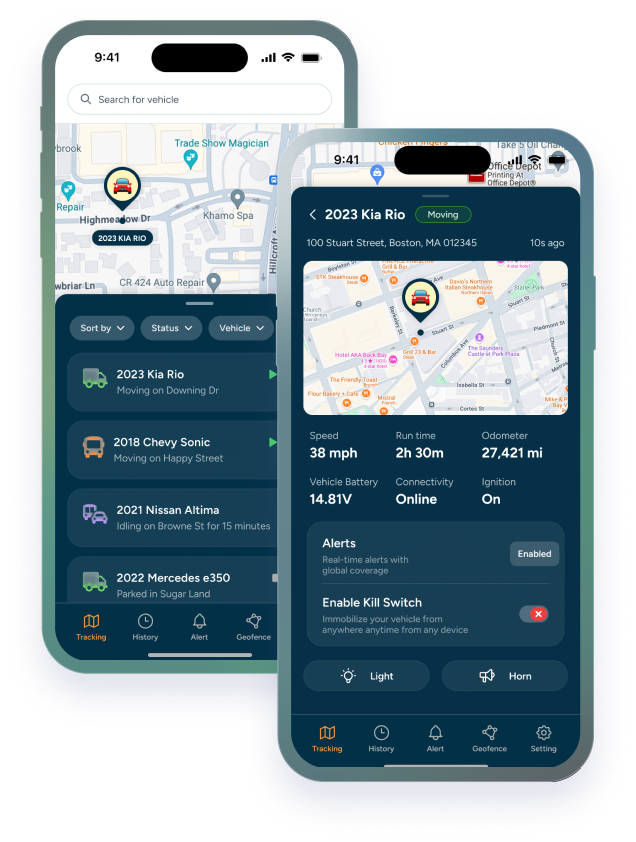

Picking a GPS tracker for your business sounds straightforward until you're actually doing it. There are hardwired devices, battery-powered options, real-time trackers, periodic reporters, units built for trucks, units built for trailers, and about a dozen feature combinations in between. The wrong choice doesn't just waste money; it creates blind spots in your operation that you won't notice until something goes wrong.
This guide cuts through the noise. Whether you're looking for a GPS tracker for your business vehicles, trying to keep tabs on equipment out in the field, or building visibility across a mixed fleet, here's the framework to get it right the first time.
Start With the Type of Asset You're Tracking
Before you look at a single spec sheet, get clear on what you're actually tracking. The asset type determines almost everything else: power source, mounting method, reporting needs, and which features actually matter.
Trucks and vans. These are the easiest case. They have a consistent power supply, a standard OBD-II port in most cases, and they move frequently enough that real-time data is genuinely useful. A hardwired or plug-in vehicle tracking device is the natural fit.
Trailers and towable equipment. No engine, no constant power, irregular movement. You need a battery-powered trailer GPS tracker built for long idle periods with motion-triggered alerts. Reporting frequency is a critical setting — too aggressive and you'll drain the battery in days.
Heavy equipment and machinery. Excavators, skid steers, generators, compressors. These often live on job sites for weeks at a time. An equipment GPS tracker with a rugged enclosure, long battery life, and geofence alerts for after-hours movement is the right tool here.
Portable tools and high-value assets. Smaller but expensive. Battery-powered compact trackers with Bluetooth fallback work well when GPS signal isn't always guaranteed.
|
TRACKHAWK GPS TIP If your operation runs a mix of asset types — which most do — resist the urge to standardize on one tracker. A single solution applied to everything almost always means compromises that cost you visibility somewhere. |
Real-Time vs. Periodic Tracking: Which Do You Actually Need?
Real-time tracking and periodic tracking are fundamentally different products. Understanding which one fits your use case will save you from overpaying or underbuying.
Real-time tracking pings location every few seconds. It's what powers live maps, speeding alerts, geofence breach notifications, and accurate drive-time reporting. For any truck tracking device managing drivers on active routes, real-time is the baseline. You can't coach driver behavior or respond to an incident with data that's an hour old.
Periodic tracking checks in on a schedule; every 15 minutes, every hour, every 4 hours, or even once a day (based on how you decide it to be). For assets that don't move often, this is all you need, and it's far more battery-efficient. A trailer sitting in a storage yard doesn't need a second-by-second location update. A daily check-in confirming it's still where it should be is enough; unless it moves, at which point motion-triggered alerts close the gap.
|
“ |
The question isn't which is better — it's which matches the asset. Real-time for moving vehicles with drivers. Periodic with motion alerts for equipment and trailers at rest. Use both across a mixed fleet and you'll have the right data everywhere. |
Do You Need Theft Recovery Features?
If the asset has significant value and leaves your direct control — which describes most business assets — theft recovery features deserve serious consideration. Not all GPS trackers handle this equally well.
Geofence alerts. The most basic theft-deterrent feature. Set a virtual boundary around a job site, yard, or parking area and get an instant notification if the asset crosses it outside of working hours. Available on most GPS trackers for business, but worth confirming the alert speed — a 10-minute lag on a geofence breach is much less useful than an instant notification.
Motion detection. For non-motorized assets especially, knowing the moment something moves unexpectedly is more valuable than knowing where it is right now. Good trailer GPS trackers and equipment trackers have accelerometer-based motion triggers that fire an alert the instant the asset is disturbed.
Hidden installation. A tracker someone can find and remove in 30 seconds isn't a theft deterrent — it's a false sense of security. Look for low-profile hardwired installs on vehicles and tamper-resistant magnetic or bracket mounts for equipment. Some GPS trackers for company vehicles are designed specifically to be concealed.
Historical route playback. In a theft event, route history lets you trace exactly where the asset went, which is critical for recovery and for working with law enforcement. Trackhawk stores up to a year of route history — a meaningful differentiator when most competitors cap it at 30–90 days.
Hardwired vs. Battery-Powered GPS Trackers
Installation method is where a lot of buyers get tripped up. Both options are legitimate, the right one depends entirely on the asset.
Hardwired trackers are wired directly into the vehicle's electrical system. They draw continuous power, never need a battery swap, and can support higher reporting frequencies without any trade-offs. They're the standard choice for any dedicated vehicle tracking device — trucks, vans, company cars, or powered equipment with an accessible wiring harness. The installation takes 30–60 minutes per vehicle and is typically a one-time setup.
Battery-powered trackers are self-contained units that attach magnetically or with a bracket. Installation takes minutes with no tools required. The trade-off is battery management — you need to choose a reporting interval that balances visibility with longevity, and you'll need a maintenance schedule for battery replacement or recharging depending on the unit.
|
TRACKHAWK GPS TIP OBD-II plug-in trackers sit between the two — they draw power from the vehicle's diagnostic port with no wiring required, making them quick to deploy and easy to move between vehicles. A solid option for smaller fleets or proof-of-concept rollouts before committing to hardwired installs. |
For a mixed fleet of trucks and trailers, the practical answer is usually both: hardwired or OBD on every powered vehicle, battery-powered on every trailer and piece of standalone equipment.
Questions to Ask Before Buying a GPS Tracker
Before you commit to any GPS tracker for company vehicles or equipment, run through this checklist. The answers will quickly narrow your options and surface any red flags before you're locked into a contract.
|
# |
Question to Ask Before You Buy |
|
01 |
What is the minimum contract length? Month-to-month vs. annual matters. Avoid long lock-ins until you've validated the platform fits your workflow. |
|
02 |
How fast are geofence and motion alerts? Seconds vs. minutes is a real difference. Ask for specifics, not marketing language. |
|
03 |
How long is route history stored? 30 days is the industry floor. Look for 90 days minimum — a full year if theft recovery or compliance matters to you. |
|
04 |
Does the platform support both motorized and non-motorized assets? If you run trailers or equipment alongside vehicles, you need one platform that handles both. |
|
05 |
What does the mobile app actually show? Live map, trip history, and alerts should all be accessible on mobile — not just desktop. |
|
06 |
Is there a per-asset fee or a flat rate? Per-asset pricing scales against you as your fleet grows. Know what you're signing up for. |
|
07 |
What happens to data if I cancel? Can you export your trip history? Some providers lock or delete your data on cancellation. |
Find the Right Tracking Setup With Trackhawk GPS
Trackhawk GPS was built specifically for the kind of mixed-asset operations that most GPS platforms weren't designed to handle well; businesses running trucks, trailers, and equipment side by side, often with small teams and no dedicated fleet manager.
Every Trackhawk plan includes real-time tracking for powered vehicles, battery-powered options for trailers and equipment, geofence and motion alerts, and a full year of route history storage. No per-seat fees. No complicated tier structures. One platform that covers your entire asset portfolio.
If you're still figuring out which setup makes sense for your specific mix of assets, our team is straightforward about it; we'd rather help you get it right than sell you something that doesn't fit
Know where everything is. Every asset. Every time.
|
Not sure which tracker fits your operation? Trackhawk GPS works with businesses of all sizes — from single-truck owner-operators to multi-asset fleets. We'll help you find the right setup for every asset you run.
|
|
Talk to Our Sales Team today to schedule a free demo call! |