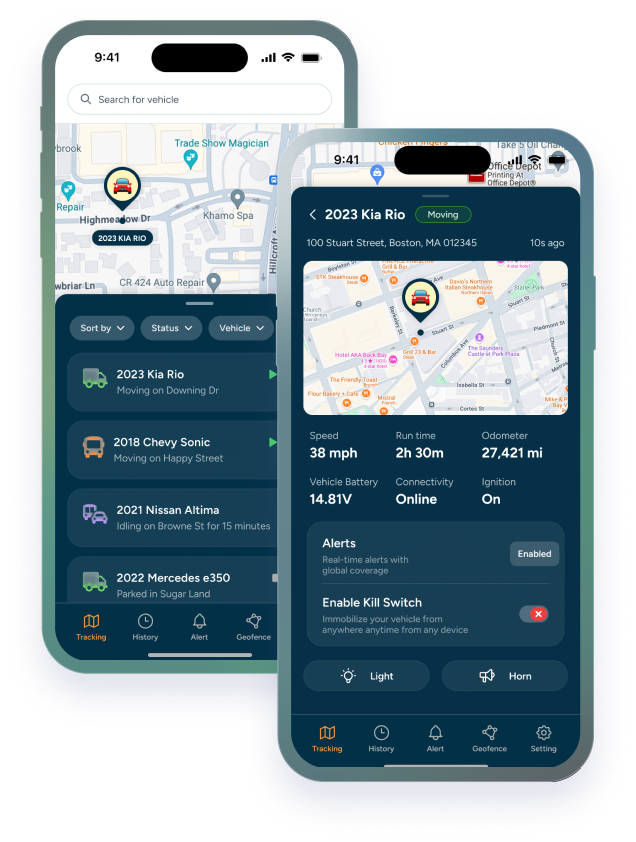

Saqr Alwadi runs Deebo Motors, a used car dealership with 25 vehicles, a growing financing operation, and a hard-learned lesson about what happens when you can't control your assets. A renter took one of his cars. Then came back and took it again. Both times, Trackhawk's kill switch stopped the vehicle cold and brought it home.
"Trackhawk GPS has already paid for itself," Saqr said. "I've used the kill switch more than 9 times, and it works instantly." That's not a feature highlight. That's what real asset control looks like for a dealer who built his operation around never being caught without it again.
That's not a sales pitch. That's what real-time asset control looks like in practice, for a used car dealer and rental operator who learned the hard way what happens without it, and built his operation around never going back.
Most auto dealerships aren't there yet. And in today's default environment, that gap is getting expensive.
What happens next depends almost entirely on how fast you can move. And for most dealerships, the answer has historically been: not fast enough.
The Reality: Defaults and Vehicle Loss in Dealerships
|
2.3M+ Auto loan defaults in 2024, exceeding Great Recession peaks |
+43% Rise in repossessions from 2022 to 2024 |
3.2% Average auto loan charge-off rate |
For franchised dealerships operating captive financing, and especially for independent auto dealerships carrying their own paper, that environment translates directly into portfolio pressure. More defaults mean more recovery operations — and more vehicles coming back damaged, depreciated, or not at all.
One often-overlooked factor: when borrowers struggle to make loan payments, they're also more likely to let their insurance policies lapse. A repossessed vehicle that comes back damaged with no coverage to offset the loss turns a recovery into a write-off.
For a dealership with a $2 million finance portfolio, a 3.2% charge-off rate means $64,000 in annual write-offs. At $5 million, it's $160,000.
|
The core question: The question isn't whether defaults will happen. In this market, they will. The question is what your dealership can do about it — and how quickly. |
Before: Delayed Response and Low Recovery Rates
To understand what GPS and kill switch technology changes, it helps to understand what the recovery process looked like without it.
A customer misses a payment. Your collections team calls, once, twice, ten times. Some customers respond; many don't. At some point, the account is escalated to a third-party skip tracer or repossession agency. The agency works off whatever information exists in the file: the address on the application, an employer listed at signing, maybe a reference contact. They drive out. The vehicle may or may not be there.
In the meantime, the clock is running. The average total recovery cost; including legal fees, towing, and auction fees; runs approximately $1,500 per repossession, and that's before factoring in the time your team invested in collections, or the condition the vehicle is in when it finally comes back.
|
The hidden cost of slow recovery: A vehicle recovered two weeks after default looks very different from one recovered in 48 hours. It may have racked up mileage, sustained damage, or depreciated past the point where auction proceeds offset the outstanding balance. For dealerships without real-time asset visibility, that gap is largely outside their control. |
After: Real-Time Alerts and Remote Control
|
Before GPS
|
After GPS + Kill Switch
|
Dealer GPS tracking changes the timeline at every stage of the delinquency lifecycle — not just at the recovery end. The first shift is in early detection: vehicles that haven't moved in days, crossed outside expected boundaries, or show unusual patterns surface as alerts before the first payment is missed.
The second shift is in leverage. A dealership car tracker paired with a starter kill device gives your finance team a non-confrontational way to prompt engagement. Most customers will reach out before a disable is triggered. The tool works primarily as a deterrent , and deterrents are cheaper than recoveries.
The third shift is in recovery speed. When a vehicle does need to be repossessed, dealer GPS tracking eliminates the search phase entirely. GPS-equipped vehicles maintain an 80% recovery success rate — a dramatic improvement over outcomes dealerships see when working from stale application data.
Faster Recovery, Lower Loss Exposure
|
Factor |
Without GPS |
With GPS + Kill Switch |
|
Recovery Timeline |
2–4 weeks |
24–72 hours |
|
Vehicle Location |
Last known address |
Real-time, exact |
|
Collections Approach |
Reactive — calls, skip trace |
Proactive — alerts + disable |
|
Repo Agent Efficiency |
Search required |
Direct dispatch |
|
Vehicle Condition at Recovery |
Unknown — often damaged |
Controlled — faster, cleaner |
|
Write-Off Risk |
High |
Significantly reduced |
The financial impact of faster recovery compounds in ways that aren't immediately obvious. Every day shaved off the recovery timeline means less mileage accumulation, less depreciation, less potential damage, and less time the vehicle spends outside your control. It also means less time your team spends managing the account — calls, escalations, skip tracing, coordination with repo agencies.
The average repossession runs approximately $1,200 per vehicle in direct expenses. But the indirect costs — time out of service, depreciated recovery value, collections labor, and write-off risk — can easily double or triple that figure on a poorly managed account. Dealership car trackers don't just help you find vehicles faster. They help you shrink the total cost of every defaulted account.
Why Visibility Changes the Entire Risk Model
Here's what most conversations about GPS and kill switch technology miss: the value isn't just operational. It's strategic.
When a dealership finance team knows it can locate and, if necessary, disable any vehicle in its portfolio within minutes, the entire risk model shifts. Deals that looked marginal on the front end become more manageable — because the downside of a bad outcome is smaller and more controllable. That confidence, compounded across hundreds of credit decisions per year, translates directly into more approvals, more revenue, and a more competitive financing operation.
It also changes the collections dynamic fundamentally. A team that relies entirely on phone calls and repo agents is always playing catch-up. A team with real-time portfolio visibility and remote control can operate proactively: catching early signals, intervening before delinquency hardens, and resolving situations before they become write-offs.
|
The bottom line: As repossessions rise, many auto dealerships have responded by tightening underwriting — requiring larger down payments, higher credit scores, more stringent verification. That's one response. But it costs you deals and customers. The smarter play is using technology to manage the risk you're willing to take — rather than shrinking your business to avoid it. |
The dealerships recovering more vehicles and writing off less aren't doing it by approving fewer customers. They're doing it by knowing exactly where their assets are, every hour of every day and having the tools to act the moment something goes wrong.
You can also know where every financed vehicle is. Act before a missed payment becomes a write-off. Request a Free Demo with Trackhawk GPS to understand how we can help you avoid write-offs.