
There's a tension that sits at the center of every Buy Here Pay Here operation: the customers you most want to help are often the ones who carry the most risk. People rebuilding credit, navigating financial setbacks, or working jobs with inconsistent schedules may need reliable transportation urgently. Your dealership exists to serve them. But every approval is also a bet.
Recent Federal Reserve research on Buy Here Pay Here auto lending reinforces that BHPH is a distinct lending segment with its own risk profile, repossession patterns, and borrower dynamics. When delinquencies rise and household budgets tighten, the reflex response is to shrink the approval box. Turn down borderline deals. Ask for larger down payments. Reduce exposure by saying no more often.
That response is understandable, but it is also costly. Every deal you turn down is revenue you will never recover, a customer you send to a competitor, and a relationship that never starts.
.jpg?width=2240&height=1260&name=Untitled%20design%20(34).jpg)
A better answer starts with rethinking what risk management actually means. For BHPH dealers, GPS tracking and starter-interrupt technology can make the downside on a deal more visible, more structured, and easier to manage. That can help dealers approve more customers without simply accepting more unmanaged risk.
The Risk vs. Revenue Tradeoff in BHPH
In traditional auto lending, risk mitigation happens mostly on the front end. You pull credit, verify income, assess the down payment, and make a decision. Once the customer drives off the lot, your leverage is limited. If they stop paying, your options become calls, notices, collections, repossession, and hope.
BHPH dealers understand this dynamic better than anyone. Strong underwriting still matters. Payment history, income stability, down payment, vehicle value, and customer communication all play a role. But underwriting alone can only predict so much.
A customer who looks marginal on paper may pay reliably. A customer who looks solid may hit a job loss, medical issue, or family emergency three months into the note. The front-end evaluation is imperfect by design.
That is why many dealers become conservative. Better to miss a deal than take a loss. But across hundreds of decisions, that logic can become a drag on growth.
Why Dealers Turn Down Otherwise Good Deals
When you look closely at declined applications, many decisions are not only about the customer. They are about exposure.
A few patterns show up repeatedly.
No reliable way to locate the vehicle. If a customer goes dark, what is your recovery plan? Without visibility, a non-paying account becomes a chase. Repo agents work from old addresses, recovery times stretch, and the vehicle may move, depreciate, or be damaged.
No deterrent against early default. Some customers miss a payment to see what happens. If the consequence is only a few calls, they may continue to avoid contact. Dealers build that risk into underwriting, which means legitimate customers with similar profiles get declined too.
No lever between a missed payment and repossession. The gap between the first missed payment and repossession is huge. Collections calls are time-intensive and often frustrating. Without tools between those extremes, delinquency becomes reactive and expensive.
These are not always customer-quality problems. They are operational risk problems. And operational risk can be managed.
How Visibility Reduces Lending Risk
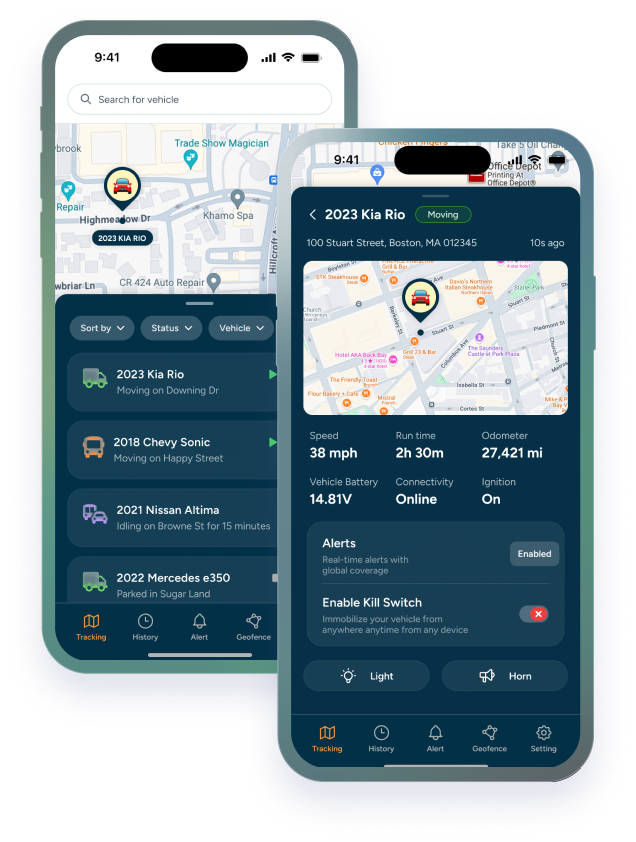
The biggest shift in BHPH risk management is the move from reactive recovery to proactive asset visibility. GPS tracking allows dealers to know where a vehicle is before the account becomes a full recovery problem.
That visibility changes the risk calculation. If a customer misses a payment but the vehicle is still local, still moving normally, and still parked at expected locations, the dealer can treat the situation differently than a vehicle that has crossed state lines and stopped reporting.
Real-time GPS tracking gives BHPH operations:
Portfolio-wide location data. Every financed vehicle can be visible from one system. Dealers can identify vehicles that have not moved, vehicles outside expected areas, and unusual patterns before a small issue becomes a major loss.
Payment-risk context. When GPS tracking is paired with account status, staff can make smarter decisions. A late account with normal vehicle activity may need outreach. A late account with unusual movement may need escalation.
Faster, cleaner recoveries. If recovery becomes necessary, GPS location data can reduce guesswork. Instead of starting from a last-known address, the team can work from current location information.
Documentation and accountability. Location history and alert logs can support internal decisions, customer conversations, and recovery documentation when used appropriately.
For dealer-specific use cases, Trackhawk’s BHPH GPS Tracking page explains how GPS tracking supports visibility, recovery, and portfolio control.
Using GPS + Kill Switch to Expand Approvals
Here's where the conversation shifts from risk management to growth strategy.
If GPS tracking and starter-interrupt technology reduce your downside on a deal through faster recovery, payment-compliance support, and earlier warning signals, then the risk profile of marginal approvals changes.
That does not mean approving everyone. It means a dealer may be able to approve customers who were previously too risky because the asset side of the deal is better protected.
This is how BHPH dealers use technology to expand approvals without expanding exposure blindly:
Approving thin-file customers. Many BHPH customers have limited credit history, not because they are irresponsible, but because they live outside the traditional credit system. Steady employment, a reasonable down payment, and clear communication may be enough when the dealer also has asset visibility.
Structuring deals with more confidence. Down payment, term length, payment frequency, and risk-tier decisions become easier when the vehicle is visible and the account can be monitored after delivery.
Saying yes where competitors say no. In a competitive used car market, the dealer who can responsibly approve more customers can build loyalty and referrals.
Reducing the cost of bad deals. Some deals will still go sideways. The question is how expensive each loss becomes. With GPS tracking and starter interrupt in place, recovery can become faster and more structured.
The result is not “no risk.” The result is managed risk.
Turning Risk Management into a Sales Advantage
Most BHPH dealers treat GPS and kill switch devices as back-office risk tools: something disclosed in the contract, handled by finance, and rarely discussed in a positive way.
That can be a missed opportunity.
Presented correctly, asset tracking technology is part of the story you tell a customer about how you are able to approve them.
A simple explanation might sound like this:
“We work with customers who are rebuilding credit. Part of how we do that responsibly is by using GPS tracking and clear payment policies. It protects our investment, which helps us make financing available to more buyers.”
That framing is honest, transparent, and less confrontational. It positions the technology as part of the approval model rather than as a surprise or punishment.
The relationship still matters. GPS tracking works best when customers understand why it is there and trust that the dealership uses it according to a clear policy.
Where the Kill Switch Fits
GPS tracking gives you visibility. A starter interrupt device gives you a structured escalation tool when an account goes delinquent and outreach fails.
The key is responsible use. A kill switch should not be the first response to a late payment. It should be part of a documented process that includes reminders, contact attempts, notice, safety checks, and state-law review.
The Trackhawk GPS Kill Switch can support BHPH dealers that need tracking plus controlled starter-interrupt functionality. When used with proper disclosures and consistent policies, it can help create a predictable payment-risk workflow instead of leaving every delinquency to manual judgment.
Building a Better Approval Framework
A stronger BHPH approval process does not rely on technology alone. It combines underwriting judgment with operational control.
A practical framework may include:
- Clear underwriting criteria
- GPS installed before delivery
- Customer disclosure during contract signing
- Real-time vehicle location visibility
- Payment reminders and escalation rules
- Geofence and tamper alerts
- Starter-interrupt policies reviewed by counsel
- Fast re-enable procedures after payment or resolution
- Documentation of all account actions
This kind of process gives the dealership confidence without removing human judgment. It also gives customers a clearer understanding of expectations from day one.
What to Measure After Expanding Approvals
If you use GPS tracking and starter interrupt to support broader approvals, the next step is measurement. The goal is not just to approve more customers. The goal is to approve more of the right customers while keeping losses manageable.
Track metrics such as:
- Approval rate by risk tier
- First-payment default rate
- Accounts cured after reminder
- Accounts escalated to starter interrupt review
- Average time to locate a past-due vehicle
- Average time to recovery
- Repo cost per recovered unit
- Write-off rate by vehicle type or deal structure
- Customer communication response rate
- Device health and tamper alerts
These numbers help separate emotion from performance and give managers a clearer way to adjust the approval box over time. If approval volume rises but recoveries stay fast and losses stay controlled, your process is working. If approval volume rises and write-offs rise faster, the policy needs to be adjusted.
Where Technology Should Not Replace Judgment
GPS tracking and starter interrupt tools should support the decision-making process, not replace it. Dealers still need underwriting standards, customer communication, staff training, legal review, and clear escalation policies.
A technology-assisted approval is still a real loan with a real customer behind it. The best BHPH dealers use GPS data to improve visibility, not to remove empathy or judgment. If a customer is communicating, maintaining the vehicle, and trying to resolve a problem, the data can help your team choose a better response than immediate escalation.
That careful balance is what makes the system sustainable: more confidence for the dealer, clearer expectations for the customer, and fewer blind spots for the collections team.
The Bottom Line
The BHPH market rewards dealers who can balance risk and opportunity. Approving fewer customers may feel safe, but it can also limit growth. Approving more customers without better controls can create losses. The better path is to manage the downside more intelligently and consistently.
GPS tracking and starter-interrupt technology help dealers convert unknown exposure into visible, documented, controllable, day-to-day risk. That can make more deals possible, improve portfolio oversight, and support better customer conversations.
More approvals. Better visibility. Faster recovery when needed. Stronger customer relationships.
That is what smarter vehicle control can support.
If you are ready to improve how your dealership manages risk, contact Trackhawk GPS to talk through a BHPH tracking and kill switch setup.