
If you're a used car dealer carrying your own paper or shopping for vehicle control technology for the first time, you've probably run into confusion about what these tools actually do. GPS tracking and kill switch systems are often mentioned together, sometimes marketed as the same thing, and occasionally confused with each other entirely.
They're not the same. But for BHPH and used car dealers, the distinction matters less than understanding why you may need both and what happens when you only have one.
For dealer operations, the goal is not to “track people.” The goal is to protect financed inventory, support consistent payment-risk workflows, and reduce the time and cost of recovery when an account goes sideways.
What GPS Tracking Does (and Doesn't Do)
GPS tracking gives you location. That's its core function: knowing where a financed vehicle is at any given moment and, in most systems, being able to see where it's been.
For a used car dealer financing in-house, that capability solves real problems. When an account goes delinquent and a customer stops responding, you're not dispatching a repo agent to a last-known address and hoping for the best. You know where the vehicle is. Recovery is faster, cleaner, and less dependent on guesswork.
Beyond recovery, GPS data gives you early warning signals. A vehicle that hasn't moved in several days, one that's traveled far outside the customer's stated area, or one showing unusual patterns can all surface in a dashboard before the first missed payment turns into a bigger issue. That's the difference between proactive outreach and reactive collections.
Modern GPS systems also layer in geofencing, which lets a dealer draw a virtual boundary and receive an alert when a vehicle crosses it. For used car dealers, that can mean knowing when a financed vehicle leaves the city, the state, or a specific radius. Visibility without confrontation.
| What GPS doesn't do: It doesn't stop anything. A customer who knows their vehicle is tracked but decides not to pay anyway can still drive the car indefinitely. GPS tells you where the vehicle is. It doesn't give you any leverage over whether it can move or not. |
|---|
What Kill Switch Systems Do (and Their Limits)
A starter control device, commonly called a kill switch, gives you control. When an account goes delinquent and your documented process allows escalation, the system can prevent the vehicle from being started until the issue is resolved.
That capability changes behavior. Many customers who know a vehicle has a starter-interrupt device installed are more likely to communicate before the situation escalates. The tool rarely needs to be used when policies are clear, disclosures are handled properly, and reminders are consistent.
Kill switch technology also creates a checkpoint before repossession. Instead of jumping from missed payment straight to a costly recovery process, dealers may have an intermediate step: notify the customer, document the account, apply the policy consistently, and prevent further use when appropriate.
This should always be handled carefully. Starter interrupt use can be regulated by state law and contract terms. Dealers should review legal requirements, disclosures, notice periods, and re-enable procedures before using any system.
| What a kill switch doesn't do: It doesn't tell you anything. A standalone starter interrupt system with no GPS integration leaves you controlling an asset you can't see. If a customer ignores the disabled vehicle and walks away, you still have to find it before you can recover it. Control without visibility is only half the equation. |
|---|
Why BHPH and Used Car Dealers Need Both Working Together
| GPS Alone | GPS + Kill Switch |
|---|---|
| Always know where the vehicle is. Early warning signals before missed payments. Faster, more informed recovery. But no leverage if a customer refuses to engage, and no way to prevent continued driving. | Full location visibility, payment-compliance support, non-confrontational escalation, faster recovery with exact location, and more complete delinquency lifecycle coverage when used responsibly. |
Together, GPS tracking and starter interrupt close the loop. You know where the vehicle is. If the account goes delinquent, you have a structured tool to prompt resolution. If the situation escalates, you can send a recovery agent directly to the vehicle's location.
That complete coverage is what changes the approval and recovery conversation. With GPS and kill switch working together, the downside on a risky deal becomes more visible, more structured, and easier to manage.
For dealers, that is the real value: less guessing, more documentation, and a more consistent process from the first missed payment to final resolution.
Key Features to Look For
| Real-Time Location, Not Delayed Pings: Some systems update slowly. For active recovery situations, lag matters. Look for reliable location visibility and on-demand updates. | |
|---|---|
| Payment-Linked Workflows: Strong dealer systems support payment-status workflows, reminders, account flags, and documented escalation steps. | |
| Configurable Alerts: You shouldn't have to log in to find out something is wrong. Look for proactive alerts for geofence crossings, inactivity, tampering, and unusual movement. | |
| Tamper Detection: Customers may try to remove or defeat tracking devices. A system that alerts you when tampering is detected closes that gap quickly. | |
| Portfolio-Wide Dashboard: Managing 50, 100, or 200+ financed vehicles requires a single view with status indicators, not account-by-account manual checking. | |
| Compliance-Supporting Workflows: Starter interrupt use is regulated in many states. A dealer system should support documentation, permissions, notices, and consistent procedures. |
These features matter because BHPH risk is not only about recovery. It is about building a repeatable process that your sales, finance, and collections teams can actually use.
How Trackhawk GPS Combines Tracking + Control in One Platform
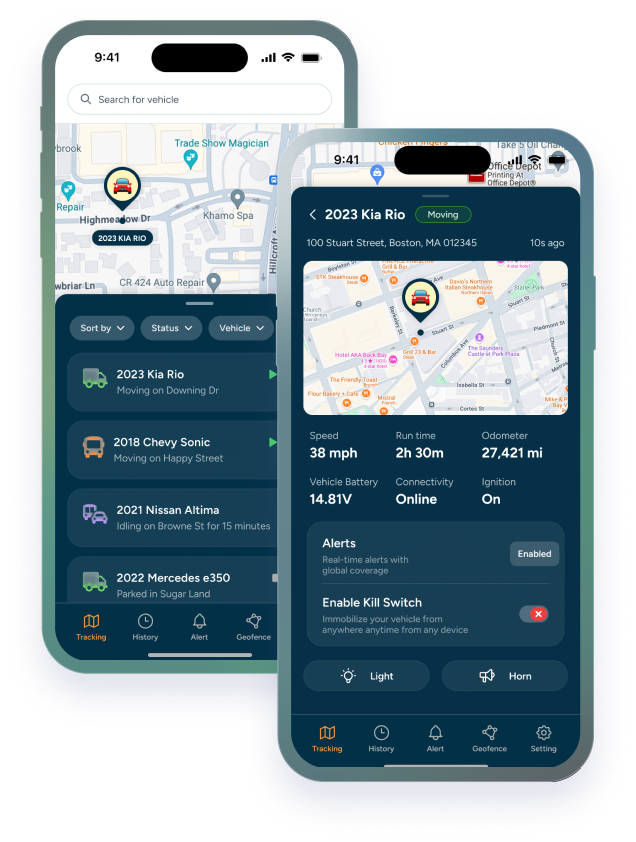
Trackhawk GPS supports BHPH and used car dealer operations with real-time GPS tracking, Smart Kill Switch technology, geofencing, alerts, and platform visibility. Instead of piecing together separate tracking and starter-interrupt tools, dealers can manage visibility and control through one system.
On the tracking side, Trackhawk GPS provides vehicle location, location history, geofence alerts, and portfolio visibility through a centralized dashboard. Your team can see financed units, flag accounts that need attention, and pull location data when it's needed for recovery.
On the control side, the Trackhawk GPS Kill Switch supports authorized starter-interrupt workflows. When used with proper disclosures, policies, and state-law review, it can help dealers create a more consistent escalation process.
For BHPH-specific use cases, Trackhawk’s BHPH GPS Tracking page explains how tracking and starter interrupt support dealer risk management, recovery, and portfolio visibility.
The integration between tracking and control is what matters. Location history, account status, alerts, and immobilization events should not live in disconnected systems. When they are connected, collections can move faster, recovery can become more precise, and documentation can be cleaner.
Compliance and Customer Communication Matter
GPS tracking and starter interrupt technology should never be used casually. Dealers should have written policies that define when devices are installed, how customers are informed, when staff can access location data, what notice is required before disablement, and how quickly vehicles are re-enabled after resolution.
At minimum, dealers should review:
- Contract disclosure language
- State starter-interrupt rules
- Notice requirements
- Privacy and location-use policies
- Staff permissions
- Re-enable timelines
- Documentation and audit logs
- Safety checks before any immobilization action
This is not legal advice. Dealer requirements vary by state and by contract structure, so legal review is essential.
The Bottom Line
GPS tracking gives BHPH dealers visibility. Kill switch systems give them control. Used separately, each solves only part of the problem. Used together, they can support a more complete process for payment risk, recovery, and portfolio management.
The best system is not about aggressive collections. It is about structure: knowing where vehicles are, documenting escalation, communicating clearly, and using starter interrupt responsibly when policy and law allow.
For used car dealers tired of choosing between portfolio protection and growth, GPS tracking plus Smart Kill Switch technology can help make both possible.