
Rental businesses operate on a different risk profile than most. You hand your assets to strangers, send them out the door, and trust they'll come back on time, in good condition, and where they're supposed to be. Sometimes they don't. A car doesn't get returned. An e-bike ends up in a restricted zone. A piece of equipment goes quiet for three days and nobody knows where it is.
GPS tracking doesn't eliminate these problems entirely, but it changes the equation dramatically. It shortens recovery time, reduces unauthorized use, gives you data to make smarter decisions, and in some cases, lets you stop a problem before it becomes a loss. Here's how it works in practice for rental operations of all sizes.
Why Rental Businesses Face Unique Tracking Challenges
Most GPS tracking use cases involve assets that stay within a controlled environment; a company's vehicles driven by its own employees, equipment moving between job sites the business manages. Rental is different. The moment an asset leaves with a customer, you've lost direct control of it. You're relying on a contract, a deposit, and the customer's good intentions.
That creates a specific set of risks that standard fleet monitoring systems aren't always designed to address:
Late and non-returns. An overdue rental is a revenue problem. A non-return is an asset loss. Without real-time visibility into where the asset is, recovery requires phone calls, escalations, and in worst cases, police reports — all of which take time your operation doesn't have.
Unauthorized geographic use. A customer renting a car in Atlanta shouldn't be driving it to Miami. An e-bike rented at a beach shop shouldn't end up on a pedestrian walkway. Rental agreements set boundaries — but without GPS enforcement, those boundaries are just words on paper.
Mileage and usage disputes. Accurate billing depends on accurate usage data. Without an objective record, mileage disputes and damage claims become he-said-she-said conversations that erode customer relationships and eat management time.
Multi-location visibility. Rental businesses with more than one location need to know which assets are where at any given time. A vehicle tracking solution that only tells you an asset exists — not where it is — doesn't help you reallocate inventory or respond to demand shifts.
|
TRACKHAWK GPS TIP The rental businesses that manage assets most effectively aren't necessarily the ones with the strictest policies — they're the ones with the best visibility. GPS tracking turns reactive recovery into proactive management. |
Preventing Unauthorized Use and Asset Theft
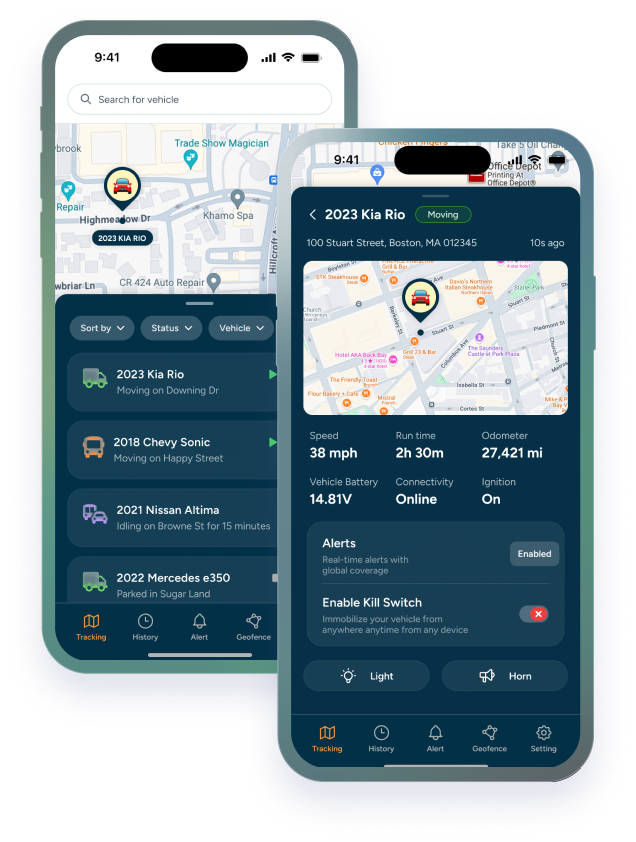
Unauthorized use and outright theft sit at opposite ends of the same spectrum — and GPS tracking addresses both. The key capabilities are geofencing, real-time alerts, and for vehicle fleets, kill switch integration.
Geofence alerts: set a boundary around an operating area, a city, or a specific zone and get an instant notification if an asset crosses it. For a car rental operation, that means knowing immediately when a vehicle leaves an authorized region. For an e-bike fleet, it means enforcing city-mandated restricted zones automatically rather than relying on customer compliance.
Kill switch for vehicles: a GPS tracker with kill switch functionality allows remote engine disable directly from the platform. For rental fleets dealing with overdue payments or non-returns, this is the most direct recovery tool available. It doesn't require a confrontation or a tow — the vehicle simply won't start until the issue is resolved. This is a hardwired-only feature, which is why professional installation matters for rental vehicle fleets.
Motion detection for non-vehicle assets: for equipment, bikes, and other assets without an engine, motion-triggered alerts fire the moment something moves unexpectedly. A bike that starts moving at 2am outside its rental window is flagged immediately — giving you time to act before it's gone.
|
CUSTOMER STORY Go Drive Atlanta, Toro Car Rental “We tried a variety of systems, but Trackhawk stood out for its ease of use, simplicity, and outstanding customer service. It had just the right amount of functionality — not too much, not too little.” • 15-vehicle rental fleet expanding to 20, based in Atlanta • Previously tested Passtime, Bouncie, Goldstar, and GetAround before switching to Trackhawk • Uses kill switch integration to recover overdue vehicles and collect on late payments • Non-visible professional installation completed in under 24 hours per vehicle • Resolved a payroll dispute using geofence data — an unexpected operational benefit • Manages entire fleet from smartphone app |
Tracking Assets Across Multiple Locations
For rental businesses with more than one pickup or drop-off point, asset visibility becomes an inventory management problem as much as a security one. Knowing that you have 15 vehicles in your fleet is less useful than knowing that 11 are at Location A, 3 are at Location B, and 1 is currently with a customer 40 miles away.
A fleet tracking system that consolidates all assets into a single dashboard view — regardless of location — gives operations managers the data to make real-time reallocation decisions. If one location is running low on available inventory while another has units sitting idle, the business can act on that information rather than discovering it during a customer call.
For rental businesses that also deal with trailers, equipment, or other non-motorized assets alongside vehicles, the same platform needs to handle the full asset mix. A trailer GPS tracker on towable equipment, combined with vehicle trackers on the fleet, gives a complete operational picture from one screen — not two separate platforms that don't talk to each other.
|
TRACKHAWK GPS TIP The most valuable multi-location insight isn't just where assets are — it's how long they've been sitting idle. Utilization data tells you which assets are working and which are collecting dust, which drives better purchasing and allocation decisions. |
Using Geofences to Monitor Rental Boundaries
A geofence is a virtual boundary drawn on a map. When an asset crosses it, the platform fires an alert. For rental businesses, this is one of the highest-value features available — and it works differently depending on the asset type.
For vehicle rental fleets: geofences define the authorized operating area for each rental. A customer who agreed to keep a car within the metro area triggers an alert the moment they cross that boundary. The alert gives the operator options: call the customer, document the violation for billing purposes, or in serious cases, initiate recovery.
For e-bike and micro-mobility rentals: geofences serve a regulatory function as well as an operational one. Cities with e-bike regulations often require operators to enforce restricted zones — pedestrian walkways, parks, certain streets. A well-configured geofence system lets operators demonstrate compliance to regulators and prevent violations before they happen, not just document them after.
For equipment rentals: geofences around job sites or authorized usage areas flag equipment that's being moved without authorization. Combined with after-hours alerts, this covers the most common equipment theft scenario: removal during off-hours when no one is watching.
|
CUSTOMER STORY “The economics of it makes it work. The value is there. The price point is good. And we are able to make more money by offering e-bikes because we have this reliable solution.” • 200-bike fleet including 18 electric bikes, beach-town rental shop • GPS tracking enabled the business to offer e-bikes as a rental category for the first time • Geofencing enforces city regulations on restricted pedestrian areas automatically • City ultimately mandated geofencing for all e-bike operators — validating the approach • Uses speed monitoring and mileage tracking for fleet performance data • Kill switch functionality available for remote asset control when needed |
Improving Asset Availability and Utilization
GPS tracking generates a continuous record of how every asset in your rental fleet is actually being used. That data is more valuable than most rental operators realize when they first start tracking.
Utilization rates by asset. Which vehicles or bikes are rented out most frequently? Which ones sit idle for days at a time? Usage data lets you right-size your fleet — investing in more of what's working and offloading what isn't.
Mileage-based maintenance scheduling. Instead of servicing vehicles on a fixed calendar schedule, GPS mileage data lets you trigger maintenance based on actual usage. High-utilization assets get serviced before they fail. Low-utilization assets don't get over-serviced. The result is lower maintenance costs and fewer unexpected breakdowns mid-rental.
Customer behavior insights. Where do customers actually go with your assets? Route history and usage patterns reveal which areas generate the most activity, which can inform marketing decisions, pricing adjustments, and pickup location strategy.
Accurate billing. Mileage disputes go away when both parties have access to objective GPS data. Overage charges become straightforward to enforce and straightforward to explain to customers — which means fewer disputes and faster resolution when they do come up.
|
“ |
The rental businesses getting the most out of GPS tracking aren't just using it to find assets when something goes wrong. They're using the data it generates every day to run a tighter, more profitable operation. |
How GPS Tracking Helps Reduce Operational Losses
Operational losses in a rental business come from several directions: non-returned assets, damage from unauthorized use, billing disputes, maintenance failures, and the management time spent chasing all of the above. Vehicle tracking solutions address each of these — not by eliminating risk, but by dramatically reducing the time and cost of dealing with it.
Faster recovery. A non-returned vehicle that gets located within hours costs far less to recover than one that sits missing for a week. Real-time location data shortens every step of the recovery process — from the initial search to coordinating with the customer, a tow service, or law enforcement.
Kill switch as a collection tool. For rental fleets where payment issues are common, remote engine disable is a direct lever. An overdue account can trigger a warning notification to the customer and, if unresolved, a disable that makes the vehicle unusable until payment is received. It's a firm but contactless approach that protects the asset without requiring a physical confrontation.
Dispute resolution. GPS data creates an objective record of where an asset was, when it moved, how fast it went, and how far it traveled. When a customer disputes mileage, claims they didn't cross a boundary, or contests a damage charge related to geographic misuse, the data speaks for itself.
Insurance documentation. In the event of an accident or theft, GPS route history provides documentation that can support insurance claims, establish liability, and accelerate the claims process. Some operators have found this benefit alone justifies the cost of the system.
Across all of these scenarios, the common thread is the same: GPS tracking for business assets converts unknowns into knowns. Rental businesses that operate with visibility respond faster, dispute less, recover more, and grow with more confidence than those flying blind.
Know where everything is. Respond before it becomes a loss.
|
Built for rental businesses of every size From 15-car rental fleets to 200-bike operations, Trackhawk GPS gives you the visibility, control, and recovery tools your rental business needs to grow with confidence. See How It Works → trackhawkgps.com |