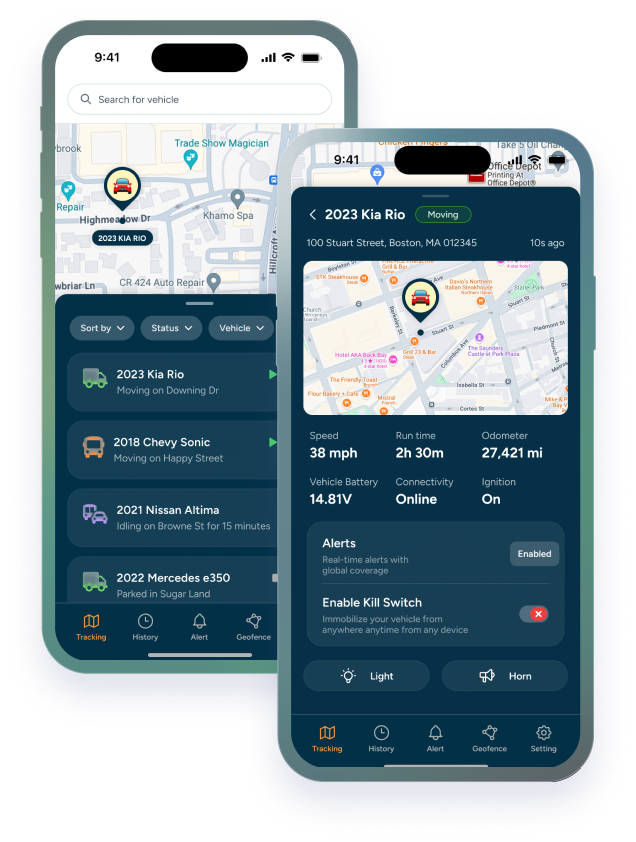

If you've been researching GPS tracking for your business, you've probably already run into this question. Hardwired or battery-powered? The answer that gets thrown around a lot is "it depends" — and while that's technically true, it's not very helpful on its own. What it actually depends on is specific: the asset type, the power source available, the reporting frequency you need, and whether features like a kill switch are part of your requirements.
This guide breaks it down clearly so you can make the right call for every asset in your operation; not just your vehicles.
How Hardwired GPS Trackers Work
A hardwired GPS tracker is wired directly into the vehicle's electrical system — typically connecting to a constant power source, an ignition-switched line, and a ground. Once installed, it draws power continuously from the vehicle, which means it never needs a battery swap and can support real-time location updates every few seconds without any trade-off.
Installation takes 30–60 minutes per vehicle and is typically done once. After that, the device requires virtually no maintenance. It reports automatically when the ignition turns on, tracks the vehicle throughout the trip, and continues monitoring even when the engine is off if connected to a constant power line.
What hardwired enables that battery-powered can't: the most significant hardwired-only capability is kill switch integration. A GPS tracker with kill switch functionality allows a fleet manager — or a lender in the case of Buy Here Pay Here dealerships — to remotely disable the vehicle's ignition. This isn't a feature you can add to a battery-powered unit. It requires a direct connection into the vehicle's electrical system, specifically into the starter circuit.
For businesses where vehicle recovery, repossession compliance, or theft deterrence is a priority, the kill switch capability alone often makes the hardwired install the only viable option.
|
TRACKHAWK GPS TIP Hardwired trackers are also the standard choice for any truck tracking device application where real-time reporting and driver behavior monitoring — speeding, harsh braking, idle time — are part of the use case. You need a consistent power supply to support that data volume reliably. |
Benefits of Battery-Powered GPS Trackers
Battery-powered trackers solve a problem hardwired units can't: tracking assets that have no electrical system to tap into. Trailers, heavy equipment, generators, containers, portable tools — none of these have a wiring harness available, which makes a self-contained battery unit the only option.
Installation speed. A magnetic battery-powered tracker goes on in under five minutes with no tools required. For a business deploying trackers across a large equipment fleet or a rental yard, this is a meaningful operational advantage. No downtime, no scheduling an installer, no vehicle modifications.
Portability. Battery-powered units can be moved between assets easily. If a trailer is sold, decommissioned, or swapped, the tracker comes off and goes onto the next asset without any reinstallation work.
Flexibility for mixed fleets. A fleet running trucks alongside trailers and equipment doesn't have to choose one approach. Battery-powered trackers handle the non-motorized side of the portfolio while hardwired units cover the vehicles — all feeding into the same platform and dashboard.
The trade-off is battery management. Reporting frequency directly affects battery life, so the right interval needs to be set per asset. A trailer GPS tracker pinging location every few seconds will drain in days. The same unit configured for live updates every 10–15 minutes can last months. Most quality platforms let you configure this per device.
|
“ |
Battery-powered doesn't mean lower quality — it means a different design priority. The best battery-powered trackers are engineered specifically for long idle periods, motion-triggered reporting, and rugged outdoor conditions that hardwired vehicle units never encounter. |
Best Use Cases for Each Type
Here's how to match tracker type to asset across a typical mixed business fleet:
|
Asset Type |
Best Tracker |
Why |
|
Delivery vans / trucks |
Hardwired |
Real-time tracking + kill switch capability |
|
Company cars |
OBD-II plug-in |
Quick deploy, easy to move between vehicles |
|
Semi-trucks |
Hardwired |
Truck tracking device with full feature set |
|
Trailers |
Battery-powered |
Trailer GPS tracker with motion alerts |
|
Heavy equipment |
Battery-powered |
Equipment GPS tracker, long battery life |
|
Portable tools / generators |
Battery-powered |
Compact unit, magnetic or bracket mount |
|
Rental assets |
Battery-powered |
Easy install/removal, no vehicle modification |
The OBD-II plug-in option — worth mentioning separately — sits between the two. It draws power from the vehicle's diagnostic port, so no wiring is required, but it still gets continuous vehicle power. It won't support a kill switch, but it handles real-time tracking and driver behavior monitoring well. It's the fastest way to get a vehicle tracking device deployed across a fleet without installation scheduling.
Theft Prevention Differences
Both tracker types contribute to theft prevention, but they do it differently — and the gap matters depending on what you're protecting.
Hardwired trackers: the kill switch capability is the headline. A GPS tracker with remote engine disable means a stolen vehicle can be immobilized as soon as it's reported, dramatically improving recovery odds and reducing the window for damage or resale. Combined with geofence alerts and real-time tracking, a hardwired setup gives you active response capability — not just after-the-fact reporting.
Battery-powered trackers: the advantage here is motion detection. A quality equipment GPS tracker or trailer GPS tracker uses an accelerometer to detect the moment an asset moves unexpectedly — before it's even left the yard. That alert fires faster than a geofence trigger because it doesn't require the asset to cross a boundary. For equipment sitting on a job site overnight, this is the most valuable theft alert available.
Route history for both: regardless of tracker type, route history is critical for theft recovery and insurance claims. Trackhawk stores a full year of location history — which matters when a theft investigation extends over months or when an insurer needs documentation of the asset's last known location and movement pattern.
|
“ |
For maximum theft protection on vehicles, hardwired with kill switch is the standard. For trailers and equipment, battery-powered with motion detection and a long route history retention window covers the gaps that a vehicle-focused setup would miss entirely. |
Which GPS Tracker Fits Your Assets?
The quick version: hardwired for anything with an engine and a wiring harness, battery-powered for everything else. But most businesses don't run a uniform fleet, so the real answer is usually both.
|
Hardwired |
Battery-Powered |
|
|
Power Source |
Vehicle electrical system |
Internal battery |
|
Reporting Speed |
Real-time (seconds) |
Live (minutes) or real-time* |
|
Install Time |
30–60 minutes |
Under 5 minutes |
|
Battery Concern |
None |
Requires management |
|
Kill Switch |
Yes — hardwired only |
No |
|
Best For |
Trucks, vans, fleet vehicles |
Trailers, equipment, tools |
|
Concealment |
Fully hidden install option |
Magnetic / bracket mount |
|
Portability |
Fixed to vehicle |
Move between assets easily |
If kill switch capability is a requirement — for fleet security, asset financing compliance, or vehicle recovery — hardwired is non-negotiable. There's no battery-powered alternative that delivers remote engine disable.
If you're tracking trailers, equipment, or any asset without a dedicated power source, battery-powered is the only practical option. The goal is matching the right device to the asset's actual characteristics, not picking one approach and forcing it across your entire portfolio.
A GPS tracker for business assets works best when it's chosen asset by asset — not purchased in bulk and applied uniformly. The fleet with the best visibility is almost always running a combination of both tracker types, mapped deliberately to the assets they're tracking.
The right tracker isn't hardwired or battery. It's whichever one fits the asset.