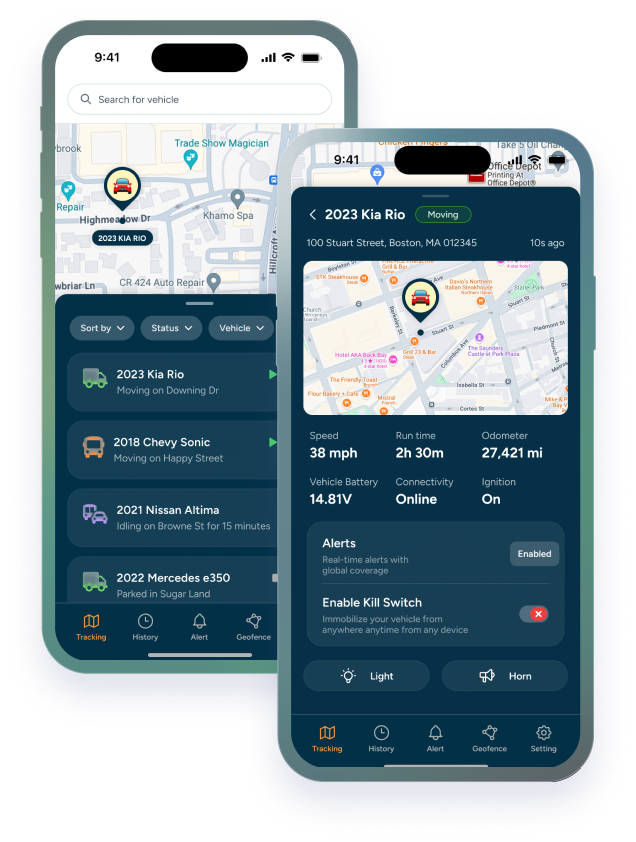

Most dash cam content is written for personal drivers, someone who wants footage in case of a fender bender on the way to work. That's not who this is for. This guide is for rental car operators, Buy Here Pay Here dealers, fleet managers, and business owners who have vehicles out in the world every day and need more than a recording device. They need visibility, accountability, evidence, and control.
The difference between a consumer car dash and a commercial fleet dash cam system isn't just specs — it's an entirely different product category. Here's what that distinction actually means in practice, and how to choose the right setup for your operation.
Why Consumer Dash Cams Fall Short for Business Use
A consumer dash cam records footage to an SD card, connects to your phone via Wi-Fi, and lets you review clips when you get home. For a personal vehicle, that's often enough. For a business running 10, 20, or 50 vehicles, it falls apart quickly.
The core problem is that consumer cams are passive; they record, but they don't respond, alert, or integrate. A fleet manager can't watch 20 SD cards. They need a system that surfaces what matters automatically, delivers footage on demand without physical access to the vehicle, and connects to GPS data so every clip has location and route context.
|
Consumer Dash Cam |
Commercial Fleet Dash Cam |
|
|
Connectivity |
Wi-Fi sync only |
LTE — always-on, real-time upload |
|
GPS Integration |
None or basic |
Built-in, 5-second real-time updates |
|
Driver Monitoring |
Road-facing only |
Dual-facing AI with in-cab coaching |
|
Event Detection |
Manual review |
Automatic — harsh braking, tailgating |
|
Cloud Storage |
Local SD or personal cloud |
Commercial cloud, instant retrieval |
|
Insurance Impact |
Indirect / personal |
10–20% commercial premium discounts |
|
Kill Switch |
No |
Yes — GPS + dash cam integration |
|
Fleet Management |
No |
Full dashboard, alerts, reporting |
|
Tamper Protection |
None |
Anti-tamper + battery backup |
The gap that matters most for business: LTE connectivity. A consumer dash cam stores footage locally. If the vehicle is involved in an incident, someone has to physically retrieve the SD card. A commercial fleet dash cam with LTE uploads event footage automatically the moment it happens — accessible from any device, anywhere, immediately.
|
“ |
A consumer dash cam tells you what happened ,after you go get the card. A commercial fleet dash cam tells you what happened, where, who was driving, and what the vehicle was doing — in real time, from your phone. |
What Are the Best Dash Cams for Commercial Fleets?
The commercial dash cam market is narrower than the consumer space, and the best dash cam options that genuinely meet business requirements are fewer than the marketing suggests. Unlike the consumer side where top rated dash cam lists are everywhere, the commercial category demands a different evaluation framework entirely. Here's what to consider:
|
★ TOP PICK FOR COMMERCIAL USE Trackhawk AI Fleet Dash Cam ✓ LTE-connected — real-time video streaming and instant event uploads, no Wi-Fi required ✓ Dual-facing AI — road and driver-facing cameras with in-cab coaching alerts ✓ Built-in GPS — 5-second real-time location updates integrated with dash cam footage ✓ Automatic event detection — harsh braking, tailgating, accidents flagged instantly ✓ Cloud video storage — retrieve any clip from any vehicle at any time ✓ Anti-tamper protection + battery backup — keeps recording even if power is cut ✓ Integrates directly with Trackhawk GPS fleet management platform ✓ 30-day money-back guarantee + lifetime hardware warranty |
Other commercial-grade options worth knowing:
BlackVue DR970X-2CH: a high end dash cam option for fleets not using a dedicated fleet management platform. Strong cloud infrastructure and solid build quality. Requires a separate GPS tracker for full fleet management integration.
Thinkware U1000: excellent video quality and parking mode performance. No built-in LTE on most models — cloud sync happens over Wi-Fi. Better suited for operations with consistent depot connectivity than fully mobile fleets.
Samsara CM32: enterprise-grade smart dash cam with strong driver coaching and ELD integration. Built for large fleets with dedicated fleet managers. Higher price point and more complex setup than most small-to-mid operations need.
|
QUICK TIP For rental businesses and BHPH dealers specifically, the GPS + dash cam integration in Trackhawk's system is the meaningful differentiator. Footage without location context is half the story; and having both in one platform eliminates the complexity of managing two separate systems. |
How Fleet Dash Cams Protect Rental Operations
Rental businesses hand their assets to strangers every day. Most of the time that goes fine. When it doesn't; an accident, a disputed damage claim, an unauthorized geographic excursion, a vehicle that doesn't come back; the rental operator is the one who absorbs the cost unless they have documentation. A quality drive cam system changes that equation entirely.
Damage claim disputes: the most common rental headache. A customer returns a vehicle with new damage and denies causing it. Without footage, you're in a he-said-she-said dispute that erodes the customer relationship even if you win. A dash cam with timestamped footage of the vehicle's condition at departure and return eliminates the argument.
Accident documentation: rental vehicles are involved in accidents that the renter may not report immediately — or at all. A dash cam with automatic event detection flags the incident in real time, preserving footage before it can be overwritten. Combined with GPS location data, you have a complete incident record without relying on the customer to provide it.
Unauthorized use detection: GPS geofencing alerts when a vehicle leaves an authorized region. Dash cam footage documents what was happening when the boundary was crossed. Together they give rental operators both the alert and the evidence — not just one or the other.
Insurance documentation: rental fleets are eligible for 10–20% commercial insurance discounts with active dash cam and GPS systems in place. The documentation those systems generate also accelerates insurance claims when incidents do occur — reducing the administrative burden that comes with every fleet incident.
|
QUICK TIP Include dash cam and GPS monitoring disclosure in your rental agreement. Customers who know the vehicle is monitored behave better — and the disclosure protects you legally if footage ever becomes part of a dispute. |
How BHPH Dealers Use Dash Cams to Reduce Risk
Buy Here Pay Here dealerships operate in a uniquely high-risk environment. The vehicles are financed in-house to customers who may have limited credit history, the lots carry significant inventory value, and the consequences of a skip — a customer who stops paying and disappears with the vehicle — can be financially serious for a small operation.
GPS tracking for BHPH is well established. Dash cam integration adds a layer that GPS alone can't provide: documentation of vehicle condition, driver behavior, and incident evidence that protects the dealer across a range of scenarios beyond just repossession.
Pre-delivery documentation: a dual-facing dash cam records the vehicle condition and the customer interaction at point of delivery. That footage establishes a baseline that protects the dealer in any subsequent damage dispute.
Skip and repossession support: GPS tracking identifies where the vehicle is. Dash cam footage documents the vehicle's condition and circumstances at the time of recovery — critical for repossession documentation and any subsequent legal proceedings.
Kill switch integration: the Trackhawk system combines GPS tracking with remote engine disable. For BHPH dealers managing overdue accounts, this is the most direct recovery tool available — the vehicle can be immobilized remotely as a payment incentive or pre-repossession step, without a physical confrontation.
False claim protection: a customer who claims a vehicle was damaged during repossession — or that a mechanical problem existed before they took delivery — is making a claim that dash cam footage can directly address. Cloud-stored footage with timestamps and location data is significantly more credible in a dispute than any paper documentation.
|
“ |
For BHPH dealers, the combination of GPS tracking, kill switch, and dash cam isn't three separate tools — it's one integrated risk management system. Trackhawk's platform delivers all three from a single dashboard. |
How AI Driver Coaching Reduces Fleet Liability
The most expensive fleet incidents are the ones that happen before a driver realizes they're in danger. Harsh braking, tailgating, phone use, fatigue — these behaviors create risk that accumulates over thousands of driving hours, and most fleets only find out about them after something goes wrong.
AI driver coaching changes the timeline. Instead of reviewing footage after an incident, the system identifies risky behavior in real time and delivers an immediate in-cab alert — a visual notification on the dash cam display, an audible warning, or both — before the situation escalates.
What the AI monitors: distracted driving and phone use, driver fatigue and eye closure, seatbelt non-compliance, tailgating and following distance, harsh braking and acceleration, lane departure.
Real-time heads-up display: the Trackhawk AI Fleet Dash Cam delivers coaching alerts directly to the driver through a real-time display. The driver gets immediate feedback without needing to interact with a phone or separate device. Managers can also send direct messages to drivers through the platform — visible on the in-cab display.
Behavior scoring and reporting: over time, AI coaching generates a behavioral record for each driver. Fleet managers can identify patterns, address issues proactively in coaching conversations, and document improvement — which matters both for HR purposes and for insurance reporting.
|
QUICK TIP Fleets that implement AI coaching typically see measurable reductions in harsh braking and tailgating events within the first 30–60 days. Those behavioral improvements directly reduce accident frequency — which is what drives the long-term insurance discount. |
How Fleet Dash Cams Lower Commercial Insurance Costs
Commercial vehicle insurance is one of the largest operating expenses for fleet-dependent businesses — and one of the most controllable through technology investment.
Direct premium discounts: many commercial insurance carriers offer premium reductions of 10–20% for fleets running active dash cam systems integrated with GPS tracking. The logic is straightforward: dash cams reduce accident frequency, improve driver behavior, and generate the documentation that makes claims faster and less expensive to resolve. Insurers price that reduced risk into your premium.
Fraud protection: commercial fleets are frequent targets for staged accident schemes — "crash-for-cash" fraud where unscrupulous drivers deliberately cause low-speed collisions to extract insurance settlements. Without footage, carriers often settle to avoid litigation, and those settlements drive premiums up regardless of fault. HD footage from a fleet dash cam shuts down fraudulent claims before they reach litigation, protecting both your claim history and your long-term rate.
Cleaner safety records: AI coaching reduces harsh braking, tailgating, and distracted driving events — the behaviors most correlated with at-fault accidents. Fewer at-fault incidents means a cleaner fleet safety record, which compounds into lower long-term risk profiles and more competitive renewal rates year after year.
Faster claims resolution: when incidents do occur, cloud-stored dash cam footage with GPS context accelerates the claims process. Adjusters get objective documentation immediately rather than waiting for witness statements and police reports. Faster resolution means lower administrative costs and less time your vehicle is out of service.
|
“ |
Talk to your commercial insurance broker before deploying fleet dash cams. Many carriers have specific requirements for the discount — LTE connectivity, dual-facing setup, cloud storage — and knowing those requirements upfront ensures your system qualifies from day one. |
What to Look for in a Commercial Dash Cam System
Not all fleet dash cams marketed as "commercial" actually meet commercial requirements. A quality dash cam for personal use and the best dash cam for a rental fleet are fundamentally different products. Here's the feature checklist that separates genuine commercial systems from consumer hardware with a fleet price tag:
|
Feature |
Why It Matters for Business |
|
LTE connectivity |
Wi-Fi-only cams can't stream live or upload events in real time. For commercial use, LTE is non-negotiable. |
|
Dual-facing camera |
Road-facing protects against external claims. Driver-facing catches distraction, fatigue, and phone use. |
|
AI event detection |
Automatic flagging of harsh braking, tailgating, and accidents — without requiring someone to review hours of footage. |
|
GPS integration |
Dash cam footage without location context is half the story. GPS ties every clip to a time, place, and route. |
|
Cloud video storage |
Local SD-only storage gets lost if the cam is stolen or damaged. Cloud retrieval means footage is always accessible. |
|
Tamper protection |
Commercial vehicles are high-value targets. Anti-tamper hardware and battery backup keep the cam recording even if power is cut. |
|
Fleet management dashboard |
Individual cams are useful. A unified dashboard covering your entire fleet is where the operational value lives. |
|
QUICK TIP Ask any vendor specifically: is LTE included, or is it an add-on? Is cloud storage included in the monthly fee, or billed per GB? Is the GPS built into the cam unit, or a separate device? The answers determine your actual total cost of ownership. |
Wired, Wireless, or AI-Integrated,Which Setup Is Right for Your Fleet?
There are three meaningful installation categories for commercial fleet dash cams, each with a different capability profile and total cost of ownership. These range from wireless dash cam setups that plug in with no wiring, to compact dash cam hardwired units, to full AI-integrated systems — and the right choice depends entirely on what your operation needs:
|
Wireless / OBD |
Hardwired (Standard) |
AI-Integrated (Trackhawk) |
|
|
Install time |
5 min — plug in |
30–60 min hardwire |
30–60 min hardwire |
|
LTE / cloud |
No |
Some models |
Yes — always-on |
|
AI coaching |
No |
No |
Yes — real-time in-cab |
|
GPS integrated |
No |
Optional add-on |
Yes — built in |
|
Parking mode |
Limited |
Yes |
Yes + battery backup |
|
Kill switch |
No |
No |
Yes — GPS integrated |
|
Best for |
Low-risk, low-volume |
Mid-size fleets |
Commercial fleets, rental, BHPH |
For most rental operations and BHPH dealers, the AI-integrated setup is the right answer — not because it's the most expensive, but because it's the only one that delivers the full capability stack those operations need: real-time footage, GPS context, kill switch integration, and cloud evidence storage in a single platform.
Wireless and standard hardwired setups are appropriate for lower-risk, lower-volume operations where the priority is basic documentation rather than active fleet management. They work. They just don't give you the tools to actively manage risk across a fleet.
Legal Considerations for Fleet Dash Cam Use in the US
Fleet dash cam use is legal across all 50 states, but several aspects of commercial deployment require specific attention that consumer dash cam guides typically skip over:
|
Scenario |
General Rule |
What to Know |
|
Recording employees |
Legal with proper disclosure |
Must notify employees via policy or agreement. Covert recording of staff requires legal counsel. |
|
Audio recording |
Varies by state |
All-party consent states (CA, FL, IL) require disclosure. Disable audio or include in employee agreements. |
|
Customer vehicles |
Generally not permitted |
Installing cams in customer-owned vehicles without consent creates significant liability. |
|
Rental vehicle monitoring |
Legal with disclosure |
Inform renters of GPS and dash cam monitoring in the rental agreement. Standard industry practice. |
|
Footage in court |
Admissible with proper chain |
Timestamp accuracy, cloud storage integrity, and documented retrieval process matter for legal use. |
|
BHPH repossession |
Legal with proper process |
Dash cam + GPS data supports repossession documentation. Consult state-specific repossession laws. |
The employee disclosure requirement is the most commonly overlooked. Fleet operators who install dash cams in company vehicles without informing employees create potential liability under state privacy laws. The fix is simple — include dash cam and GPS monitoring in your vehicle use policy or employment agreement. Most employees accept monitoring of company vehicles without issue when it's disclosed transparently.
Rental agreement disclosure: rental operators should include a clear statement in the rental agreement that vehicles are equipped with GPS tracking and dash cam recording. This is standard industry practice, protects the operator legally, and — as a secondary benefit — tends to improve renter behavior.
|
“ |
A dash cam without a clear legal framework around its use creates as much risk as it mitigates. Get the disclosure language right upfront — it's a one-time task that protects every interaction your fleet has going forward. |
The footage you never captured is the one that costs you the most.