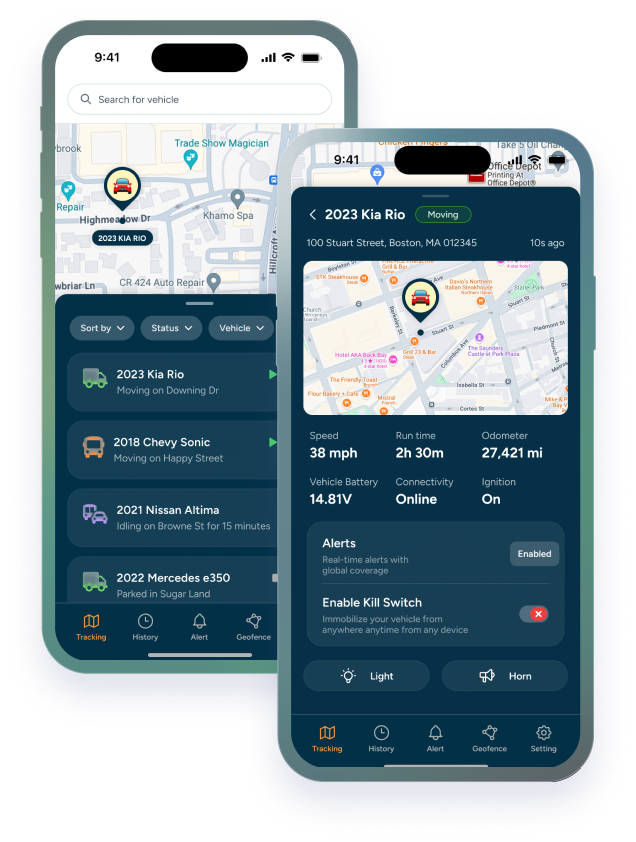

A leased truck comes with a set of terms; mileage caps, maintenance schedules, usage boundaries that are easy to write into a contract and hard to enforce without visibility. That's exactly the gap gps fleet tracking software is built to close. For a leasing company, GPS fleet tracking for leased trucks isn't about micromanaging a lessee's operation; it's about having the record that keeps small, avoidable issues from turning into lease-end penalties, disputes, or worse.
Hidden Costs of Leased Trucks
Most of the cost tied to a leased truck is visible: the lease payment, the insurance, the depreciation. GPS fleet tracking for leased trucks matters because of the costs that aren't visible; the ones that only show up at lease-end, or after something's already gone wrong. Truck lease compliance tracking exists precisely because these costs are avoidable, not inevitable.
|
Hidden Cost |
How It Happens |
What It Costs the Lessor |
|---|---|---|
|
Over-mileage |
A truck quietly runs past its lease mileage cap with no record of when or where. |
Mileage overage fees at lease-end, with no data to question them. |
|
Maintenance |
A service window gets missed because no one flagged it in time. |
Accelerated wear, voided warranties, or a truck pulled out of service unexpectedly. |
|
Liability |
A truck is involved in an incident and there's no record of route, speed, or location. |
A leasing company left to absorb risk it can't document or dispute. |
Problems Without Visibility
Without leased truck GPS reporting, a leasing company is relying on the lessee's own records to catch problems; which means the leasing company usually finds out about a problem after it's already expensive. Misreported mileage is the clearest example: without documented mileage, a lessor is stuck comparing an odometer reading at lease-end against a number nobody tracked in between, with no way to independently confirm anything in the middle.
GPS fleet tracking for leased trucks also surfaces off-route use before it becomes a bigger issue — a truck operating outside its expected territory, showing up somewhere it has no business being. Geofencing and route history turn that from a mystery into a data point, which matters whether the conversation ends up being routine or a dispute.
How GPS Prevents Penalties
None of this is about guaranteeing an outcome; no tracking system prevents every penalty or catches every issue. What fleet compliance tracking software does is shrink the window between when a problem starts and when someone notices it, which is where most of the avoidable cost lives.
Real-time tracking is the foundation: GPS fleet tracking software that shows live location and movement means a lessor isn't waiting for a phone call or a lease-end reconciliation to know something's off. Geofencing adds a layer on top of that — fleet tracking software that flags when a truck leaves an expected zone, so off-route use gets noticed in days, not months. And maintenance alerts close the loop on the least glamorous but most consistent source of cost: fleet tracking for maintenance compliance means a missed service window shows up as a flag, not a breakdown.
|
TRACKHAWK GPS TIP Set mileage and geofence alerts at the lease's actual terms, not generic defaults. A threshold that matches the contract catches problems while there's still time to do something about them — a generic one just tells you after the fact. |
Trackhawk GPS Benefits
Trackhawk's role in all of this is straightforward: give a leasing company the visibility to catch these issues while there's still time to act on them. Alerts flag the moment something crosses a threshold — a mileage cap, a geofence boundary, a maintenance window — so gps fleet tracking software becomes an early warning system instead of a lease-end surprise. See the Truck leasing company's checklist article we prepared earlier.
Reporting turns that same data into something usable at lease-end or in a dispute. Leased truck GPS reporting means a leasing company isn't reconstructing what happened from memory or paperwork; there's a documented record of mileage, location, and usage to point to. And utilization dashboards give a leasing company visibility across its full portfolio at once — not just whether one truck is compliant, but how the whole fleet is trending, which matters when decisions are being made about renewals, replacements, or where the next lease terms need tightening.
Key Takeaway for Managers
Fleet compliance tracking software doesn't eliminate risk — leased assets will always carry some. What it does is put a leasing company back in control of the parts of that risk that are actually manageable: catching over-mileage before it compounds, catching a missed service window before it becomes a breakdown, and having a documented answer instead of a guess when a dispute comes up.
For a fleet manager, that's the practical case for fleet tracking software: not a promise that nothing will go wrong, but a real shot at catching it early enough, and proving it clearly enough, that it doesn't turn into a cost the leasing company didn't see coming.