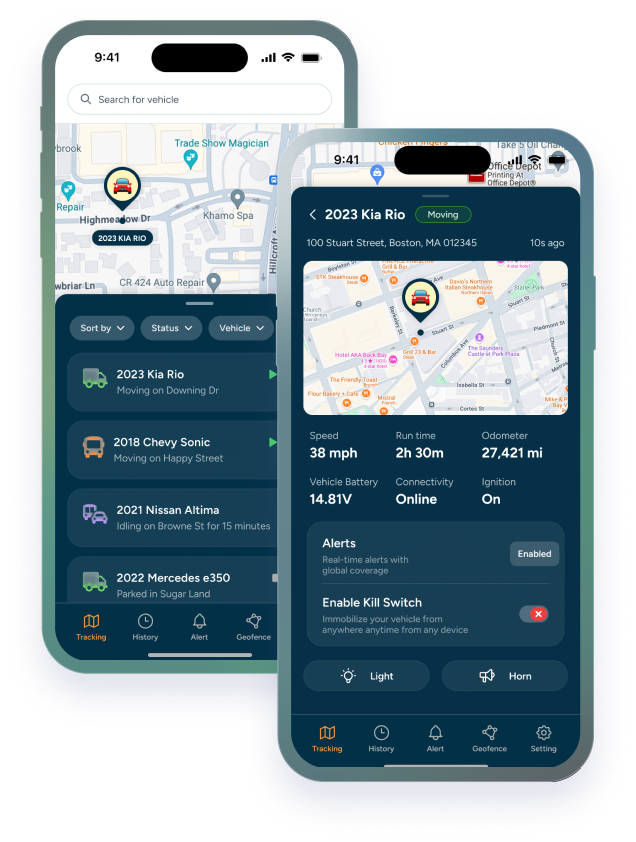

For decades, fleet maintenance ran on a simple rule: every three months, or every 3,000 miles, bring the vehicle in. The rule wasn't wrong, exactly; it was just built for an era when nobody had a better way to know what was actually happening inside a truck between service visits.
That era is ending. Fleets are shifting from calendar-based routines to fleet maintenance tracking built on real vehicle data: mileage, engine hours, diagnostic codes, and driving behavior. It's not a Trackhawk GPS invention. It's an industry-wide move toward data-driven fleet maintenance, and fleet maintenance tracking software is quickly becoming the standard way operators manage it. This post looks at why the old rule is breaking down, what's replacing it, and where the industry is headed.
Why "every 3 months" is a bad rule for fleet maintenance
Calendar-based fleet maintenance treats every vehicle the same, regardless of how it's actually used. A box truck that sits mostly idle in a yard and a delivery van that runs 12 hours a day in stop-and-go traffic will hit wildly different wear points long before either one hits the same time-based maintenance interval. One gets serviced too early, wasting labor and parts. The other gets serviced too late, after the wear has already turned into a bigger repair.
The problem isn't that fleet managers picked a bad number. It's that a fleet maintenance schedule built purely on time can't account for how differently vehicles in the same fleet are actually driven. Two trucks bought the same week can age at completely different rates, and a rule that ignores that gap either overspends on maintenance or under-catches wear — usually both, on different vehicles in the same fleet.
The rise of usage-based service triggers (mileage, engine hours, IoT data)
The alternative is usage-based fleet maintenance: triggers set by what a vehicle has actually done, not by how many days have passed. Mileage is the obvious one, but engine hours matter just as much for vehicles that idle a lot; a refrigerated truck running its engine for hours at a delivery dock accumulates wear that odometer-based tracking misses entirely.
IoT data adds a third layer. OBD-II connected devices can flag fault codes, harsh braking patterns, or engine temperature anomalies as they happen, rather than waiting for a scheduled inspection to catch them. Fleet maintenance based on mileage and engine hours, layered with real-time diagnostic alerts, gives fleet managers a picture that's specific to each vehicle instead of a one-size-fits-all interval.
|
A rule built on time can't tell the difference between a truck that's been driven hard and one that's been sitting idle. Usage data can. |
This is the same foundation behind mobile fleet tracking systems that many operators are already using for location and routing — the same telematics hardware doing double duty for maintenance visibility.
What rising parts and labor costs mean for how often fleets should be checking, not just servicing
Parts and labor costs have climbed steadily across the industry, and that changes the math on maintenance. Fleet maintenance cost tracking used to be mostly about the invoice after a service visit. Now, the bigger cost driver is often the gap between visits: a worn brake pad or a slow coolant leak that goes unnoticed for weeks because nobody was checking, only servicing on schedule.
This is where the conversation shifts from preventive maintenance cost control to something more continuous. Checking more often, using data rather than a physical inspection, catches small issues while they're still cheap. Fleet repair cost management increasingly means catching the $200 part before it becomes the $2,000 breakdown, and that only works if someone or something, is watching between scheduled services, not just at them.
Telematics is quietly replacing the maintenance clipboard
The maintenance clipboard: paper logs, spreadsheets, a mechanic's memory of which truck needs what is disappearing, and it's happening quietly rather than as a dramatic industry overhaul. Telematics maintenance tracking now runs in the background of fleets that don't necessarily think of themselves as "tech-forward." It's just become the default way the work gets done.
GPS fleet maintenance software pulls diagnostic data automatically, flags vehicles that need attention, and keeps a running history that a clipboard never could. Automated fleet maintenance tracking doesn't require a fleet manager to remember to check — it surfaces issues on its own, which matters most for smaller teams juggling maintenance alongside dispatch, routing, and everything else on their plate.
Where the industry is headed: predictive over preventive
The next step beyond usage-based triggers is predictive fleet maintenance — using accumulated data not just to flag current wear, but to forecast when a specific part on a specific vehicle is likely to fail. That's a meaningfully different model than preventive maintenance, which still assumes you're servicing on a schedule, just a smarter one.
Data-driven preventive maintenance is the bridge fleets are on right now; fleet maintenance analytics — patterns across a whole fleet's history — are what eventually gets them to true prediction. It won't happen overnight, and no single vendor is going to "solve" it in one product release. But the direction is clear: fewer decisions based on the calendar, more based on what the data is actually saying about each vehicle.
For fleets thinking about where to start, the practical entry point isn't a full predictive-maintenance overhaul — it's simply moving maintenance decisions onto real usage data instead of a fixed schedule. That's the shift already underway, and it's one that pays off well before anything gets labeled "predictive."