
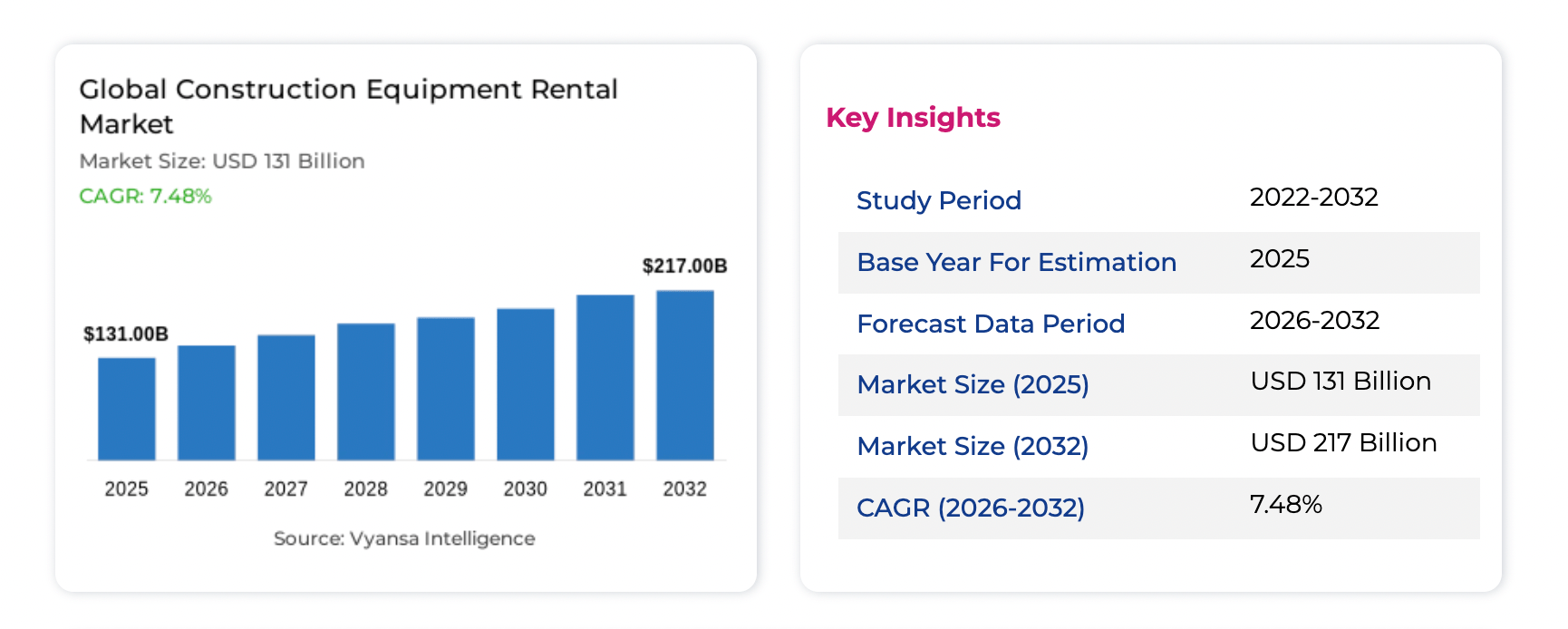
The construction equipment rental market is experiencing one of its most significant growth phases in decades. With the global market valued at over $130 billion in 2025 and projected to push past $217 billion by 2032, rental companies are navigating a landscape rich with opportunity and complexity.
More contractors than ever are choosing to rent rather than buy. Sixty-two percent of contractors now prefer renting equipment over ownership, driven by the desire to preserve capital, avoid depreciation risk, and stay flexible across project timelines. Infrastructure stimulus programs, urbanization, and tighter credit markets are all accelerating the shift.
But here's what the market reports won't tell you: growth is only profitable if you can manage what you've got. And for many rental companies scaling their fleets to meet demand, that's where things start to break down.
A Booming Market With Real Operational Pressure
The numbers are compelling. The U.S. construction equipment rental market alone is forecast to grow from $24 billion in 2024 to nearly $40 billion by 2034. Large-scale infrastructure programs are turning speculative demand into firm, multi-year rental contracts. Digital rental transactions grew roughly 43% in 2024, and short-term project rentals surged by around 54% in the U.S.
That last figure, the surge in short-term rentals — is the one that should keep fleet managers up at night.
Short-term contracts mean higher equipment turnover. More pickups, more drop-offs, more handoffs between job sites. More opportunities for equipment to go missing, sit idle, or get damaged outside of authorized hours. The very growth driving this industry is also amplifying every operational risk that comes with managing a dispersed fleet of high-value assets.
The equipment theft problem alone is staggering. According to the National Equipment Register, theft costs U.S. companies between $300 million and $1 billion every year — and those losses cascade into project delays, inflated insurance premiums, and damaged client relationships.
What Leading Rental Companies Are Doing Differently
The rental companies pulling ahead right now aren't just expanding their fleets — they're wiring those fleets for intelligence. Telematics-enabled fleet installations rose approximately 36% in 2024, and major players like United Rentals, Herc Rentals, and Sunbelt Rentals have all made telematics and GPS-enabled asset tracking central to their operational strategy.
The logic is straightforward: you can't manage what you can't see.
Here's what GPS and telematics are doing for forward-thinking rental operators today.
1. Real-Time Location Visibility Across Every Asset
Construction equipment moves constantly between job sites, staging areas, and yards. Without real-time tracking, locating a specific excavator or compressor on a sprawling site becomes a time-consuming manual process that stalls productivity.
GPS fleet tracking gives your team an instant map view of every asset, updated in real time. Whether it's a compact mini-excavator on a residential build or a crane servicing a commercial tower, you know exactly where it is. For rental companies managing hundreds of units across multiple clients and job sites, this isn't a nice-to-have, it's the foundation of operational control.
2. Geofencing That Protects Your Assets After Hours
Rental equipment left on job sites overnight is a theft magnet. A GPS-enabled geofence allows you to draw a virtual boundary around any site or area and receive an instant alert the moment a piece of equipment exits that zone — or when its ignition is triggered outside of authorized hours.
One regional rental company with $2 million in equipment recovered $140,000 in stolen equipment within under a year after implementing GPS tracking with geofencing. A regional contractor cited recovering a $68,000 excavator within hours of theft, with GPS coordinates precise enough to locate it in a rural storage facility where thieves had attempted to conceal it.
GPS doesn't just help you recover stolen equipment. It deters theft in the first place. Criminals know tracked equipment is a liability — and that alone is worth the investment.
3. Utilization Data That Eliminates Guesswork From Billing and Dispatch
In equipment rental, an asset that isn't earning is losing. Knowing exactly how many hours a machine was actually in operation — versus how long it sat idle — is critical for accurate billing, smart dispatch decisions, and knowing when to pull a unit back.
GPS and telematics give you runtime hours, idling reports, and usage trends for every piece of equipment in your fleet. This data serves multiple purposes simultaneously:
- Billing accuracy: Generate invoices based on verified usage data, not estimations. This protects revenue and builds client trust.
- Fleet right-sizing: If a machine on a job site has been sitting idle for two weeks, you can reassign it or recover it — rather than letting a client continue renting an asset they're not using while another client goes without.
- Smarter procurement: Understanding real utilization patterns across your fleet tells you what equipment categories to add, what to retire, and where your highest-demand assets are concentrated.
United Rentals has reported that customers using their GPS-enabled fleet management platform cut annual rental costs by up to a third through utilization-informed decisions. That kind of efficiency gain is available to any rental operation that can see what their assets are actually doing.
4. Preventive Maintenance That Keeps Your Fleet Earning
Unplanned downtime is one of the most expensive events in equipment rental. A machine that breaks down mid-project doesn't just generate a repair bill — it creates a service failure that damages client relationships and can cost you future contracts.
GPS and telematics track engine hours, fault codes, and equipment condition in real time, enabling you to schedule maintenance before something fails rather than after. Automated alerts notify your team when a service interval is approaching or when a fault code suggests an emerging issue. Warranty tracking ensures you're never missing a covered repair.
The payoff is fewer emergency repairs, extended equipment lifespan, and a fleet that spends more time on revenue-generating jobs and less time in the shop.
5. Client Transparency That Sets You Apart
The construction equipment rental market is becoming more competitive, not less. As digital platforms and telematics become standard, clients will increasingly expect transparency — accurate ETAs for equipment delivery and pickup, verified usage reports for their own project records, and fast responses when they have questions about asset location or status.
GPS and telematics give you the data to deliver all of this. Automated usage reports, on-demand location sharing, and verified service history become differentiators that justify premium pricing and deepen client loyalty in an industry where switching costs are otherwise low.
The ROI Case for GPS in Equipment Rental
The business case for GPS and telematics in construction equipment rental isn't theoretical. Industry data from GPS vendors shows that rental companies using GPS tracking typically see:
- 37% average reduction in theft claims
- Recovery of 3–5% of annual fleet value that would otherwise be lost to theft or misplacement
- Payback periods typically under six months from implementation
For a fleet worth $1 million, GPS-enabled loss prevention alone is worth an estimated $30,000–$50,000 per year in recovered assets and avoided replacement costs. Add in billing accuracy, reduced maintenance spend, and better utilization, and the numbers compound quickly.
The Market Is Growing. Your Visibility Into It Should Too.
The construction equipment rental industry's trajectory is clear. Demand is rising, contracts are diversifying, and the operational complexity of managing a modern rental fleet is increasing in lockstep. The rental companies that will win the next decade are the ones investing now in the infrastructure to manage their fleets intelligently — not just expand them.
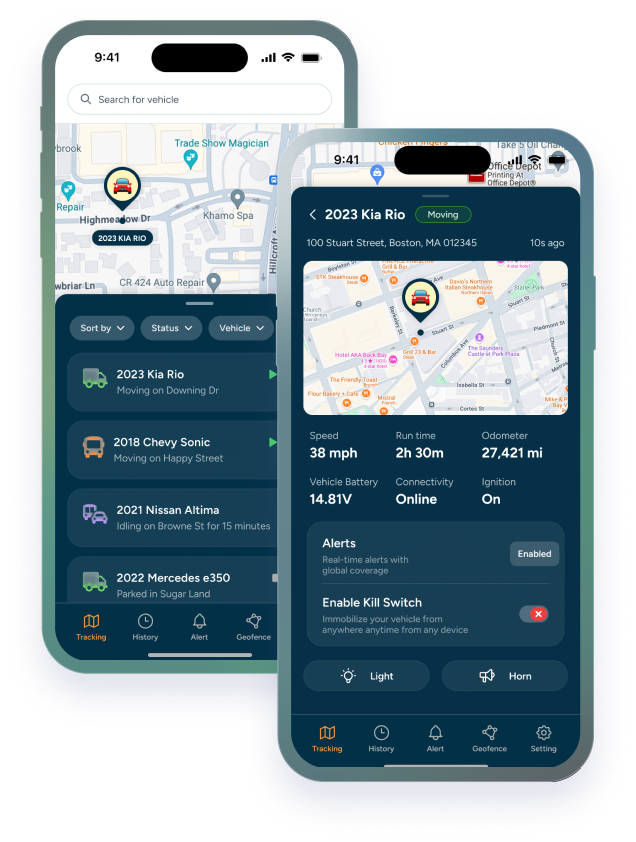
TrackHawk GPS is built for exactly this challenge. Real-time location tracking, geofencing, utilization analytics, maintenance scheduling, and automated reporting, all in a single platform designed for equipment rental operations.
Ready to see what full visibility over your fleet looks like?
Book a free demo with TrackHawk GPS →
Sources: Grand View Research, Fortune Business Insights, Mordor Intelligence, National Equipment Register, GPS Insight, United Rentals, AirPinpoint